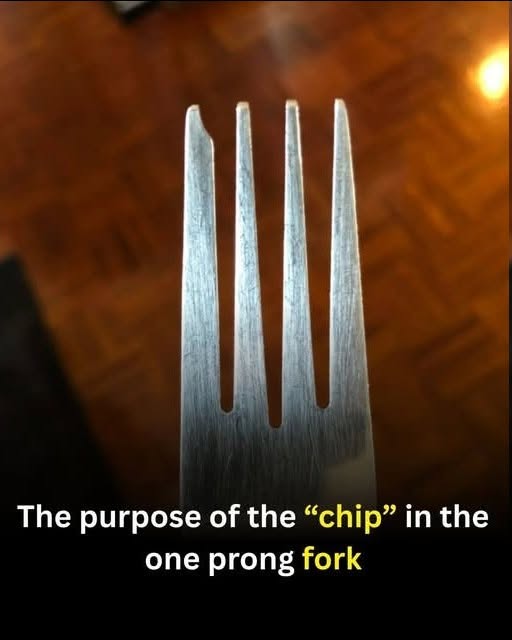
Have you ever picked up a fork and noticed that one of its prongs looks slightly different from the others? Maybe one tine appears wider, a bit shorter, or even slightly flattened compared to the rest. At first glance, it can seem like a defect in the utensil—perhaps damage from years of use or a minor manufacturing mistake.
But if you start paying attention, you may realize something interesting. This feature appears on many forks, especially in older flatware sets or certain restaurant utensils. When the same “odd” detail shows up repeatedly, it becomes clear that it probably isn’t accidental at all.
In fact, that unusual prong is often the result of intentional design.
For decades, utensil designers have experimented with small changes that make everyday dining tools more versatile and practical. One such design is the cutting fork, a utensil created with a slightly modified tine that allows the fork to perform more than one task at the table.
What might look like a flaw is actually a clever solution that dates back many years. Understanding the purpose of that unusual prong reveals how much thought goes into even the most ordinary items in our kitchens.
Let’s explore the story behind this small but fascinating design feature and why it still appears in flatware today.
A Small Detail That Catches the Eye
Most forks follow a familiar design. They typically have four slender prongs, also called tines, that are evenly spaced and identical in shape. The prongs are slightly curved and tapered to help pick up food easily.
Because this design is so common, anything that looks different tends to stand out immediately.
That’s why a fork with a slightly unusual prong can seem puzzling. One tine might look wider than the others, or it might appear flattened near the tip. Sometimes the edge of the prong even looks almost like a tiny blade.
Many people assume the utensil has been bent or damaged.
Others believe it might be a manufacturing mistake.
But when the same design appears across multiple forks, especially in matching sets, it becomes clear that the feature was intentional from the start.
The purpose behind it lies in making the fork more versatile.
Introducing the Cutting Fork
The fork with the slightly modified prong is often referred to as a cutting fork.
Unlike a standard fork, which is primarily used to spear and lift food, a cutting fork includes one tine that is slightly broader or flattened. This change may seem subtle, but it serves a practical purpose.
The wider prong can help gently divide softer foods without requiring a knife.
For example, imagine sitting down to a meal that includes:
Cooked vegetables
Pasta
Soft fish
Omelets
Tender meats
In many of these situations, the food can be separated easily with just a little pressure. A standard fork might struggle to cut through it smoothly, but a wider or slightly flattened tine can make the task easier.
The modified prong acts almost like a tiny cutting edge.
It isn’t meant to replace a knife entirely, but it adds a bit of extra functionality to the utensil.
Meanwhile, the other prongs remain narrow and pointed so the fork continues to function normally for spearing food.
Practical Convenience at the Table
The idea behind the cutting fork is simple: convenience.
Instead of reaching for a knife every time you want to separate a piece of food, the fork itself can handle small tasks.
Imagine eating a plate of roasted vegetables or a piece of tender fish. With a traditional fork, you might need to press repeatedly or switch to a knife to break the food apart.
With a cutting fork, the wider prong provides extra leverage and a slightly sharper edge that can make the job easier.
This small feature reduces the need for additional utensils during casual meals.
And in everyday dining, small conveniences like that can make a noticeable difference.
A Design That Became Popular in the 20th Century
For Complete Cooking STEPS Please Head On Over To Next Page Or Open button (>)

Wrap potatoes in tin foil and put in crock pot. Enjoy this lip-smacking result

3-Ingredient Beef Cracker Bites

Low-Carb Chocolate Peanut Butter Cloud
How to Cook Corn on the Cob with Just 2 Simple Ingredients: The Secret to the Sweetest, Most Flavorful Summer Corn

Two ingredients Reed Diffuser